• About us
  • Raising the Bar
  • Raising your Game
  • The Extra G - Geopolitical
  • Risk Matters - Roundtables
  • Leadership Team
  • Events
  • Blog
  • Contact
  • Menu

The Risk Coalition

  • About us
  • Raising the Bar
  • Raising your Game
  • The Extra G - Geopolitical
  • Risk Matters - Roundtables
  • Leadership Team
  • Events
  • Blog
  • Contact

Beyond compliance: what does principled decision-making look like in the boardroom?

November 13, 2026

Good governance is not simply about making the right decision. It is also about being able to demonstrate that the decision was reached in the right way.

That was one of the strongest themes to emerge from the Risk Coalition's latest Risk Matters roundtable, which explored The Art of Principled Decision-making with Roger Steare, the Corporate Philosopher. The discussion brought together experienced non-executive directors, risk professionals and governance practitioners to consider a deceptively simple question: how do boards make good decisions when the answer is neither obvious nor contained in the rulebook?

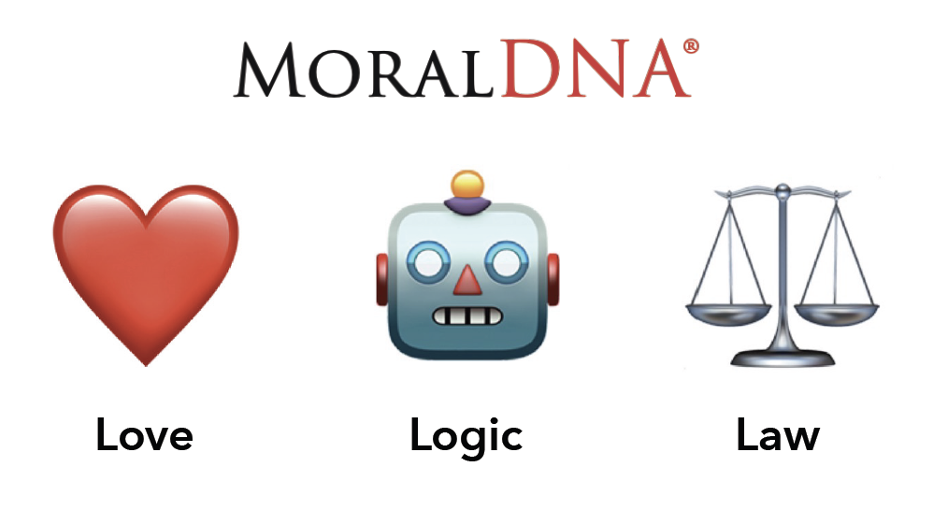
At the heart of the discussion was a framework comprising three complementary "voices": Love, Logic and Law. Love asks who may be helped or harmed by a decision. Logic asks what the facts are, what assumptions are being made and what outcomes are sought. Law asks what the rules require, what promises have been made and whether the outcome is fair. It is deliberately simple. But the discussion suggested that simplicity may be part of its value.

Compliance is the floor, not the ceiling

Boards are familiar with the regulatory and legal dimensions of decision-making. Yet an important distinction emerged between asking "What are we permitted or required to do?" and "What should we do?"

As Roger Steare put it, "compliance is the floor, conscience is our ceiling". The supporting research presented to the roundtable suggested that behaviour changes significantly when people enter the workplace: compliance and rules become more dominant while consideration of the human impact of decisions can become weaker.

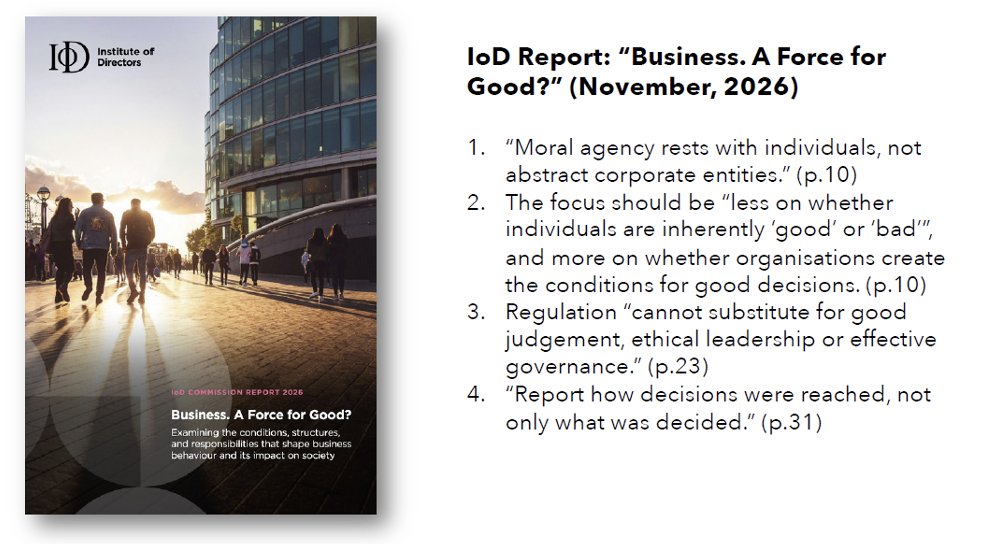
This matters because regulation cannot anticipate every situation a board will encounter. The recently published Institute of Directors report, Business. A force for good?, discussed during the session makes a related point: regulation cannot substitute for good judgement, ethical leadership or effective governance. It also argues that moral agency ultimately rests with individuals rather than an abstract corporate entity.
For NEDs, the implication is important. Compliance should be a starting point for challenge, not necessarily its conclusion.

From decision-taking to decision-shaping

Another theme was the distinction between shaping a decision and formally taking it. Too often, the board is presented with a carefully framed recommendation after much of the substantive debate has already occurred within management. Alternatives may have disappeared from the paper, assumptions may be implicit, and the board can find itself approving rather than genuinely deciding.

The practical response is not for NEDs to rerun management's work. It is to ask management to show its workings. What alternatives were considered? What assumptions underpin the recommendation? What evidence contradicts it? Which stakeholders will bear the consequences? What would have to be true for the proposed course of action to be wrong? Those questions turn challenge away from second-guessing management and towards testing the quality of the decision-shaping process. They also address one of the discussion's recurring concerns: boards can place legitimate trust in management, but that trust needs to be capable of verification.

Good challenge needs time and permission

Of course, better questions achieve little if the board environment does not allow them to be asked. The roundtable challenged the familiar problem of overcrowded agendas and insufficient time for genuinely difficult decisions. One example involved an executive meeting expected to consider ten decisions in 90 minutes. For a material strategic or ethical judgement, nine minutes is unlikely to permit meaningful contribution, let alone genuine dissent.

This brings the role of the Chair sharply into focus. Does the agenda create time for the decisions that matter most? Are alternative views actively elicited? Can a director challenge the framing of the question, not simply the recommendation? And is constructive dissent regarded as useful rather than obstructive?
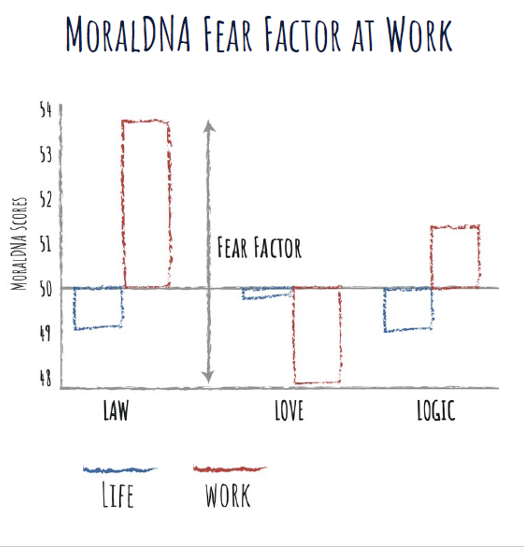

MoralDNA chart: The MoralDNA chart above illustrates how the workplace is associated with a stronger preference for Law - following rules - and a weaker voice of Love - considering the impact of decisions on others.

The discussion of the Post Office Horizon scandal was a sobering reminder of what can happen when boards cease to challenge underlying assumptions and evidence. Crucially, participants also recognised that moral concern alone is insufficient. A director may ask the right question but still receive an apparently logical answer founded on incomplete or unreliable information. Good governance therefore requires both empathy and scepticism: trust, but verify.

Record the reasoning, not just the answer

A particularly relevant challenge for boards was the quality of the decision record. The principle is straightforward: significant decisions should leave a trail showing not merely what the board decided, but how and why it reached that conclusion. What information did it rely upon? What alternatives did it consider? What assumptions did it challenge? What stakeholder consequences were discussed?

This does not mean producing a transcript of board debate. Nor does it mean eliminating the possibility of mistakes. Boards operate with uncertainty, and sometimes a carefully reasoned decision will still produce a poor outcome. The more meaningful governance test is whether the board can demonstrate that, based on the information reasonably available at the time, it approached the decision with rigour, appropriate challenge and good intent.

AI should challenge judgement, not replace it

Finally, the discussion turned to artificial intelligence. The emerging proposition was striking: the most valuable role for AI in important board decisions may not be to provide the answer, but to improve the questions. Used as a "digital tap on the shoulder", AI might identify an untested assumption, prompt consideration of an overlooked stakeholder or expose a perspective that has disappeared through groupthink. But participants were clear about the danger of outsourcing moral judgement to systems trained on historical data that may themselves reproduce embedded biases. The distinction is fundamental. AI can support better human judgement; it should not absolve humans of responsibility for exercising it.

The challenge for NEDs

Perhaps the most useful conclusion from the discussion is that principled decision-making does not require boards to become debating societies or moral philosophers. It requires disciplined curiosity. Before approving the next significant decision, NEDs might simply ask: Who could be helped or harmed? What do we know, what are we assuming, and what might we have wrong? What are our legal and wider obligations? What alternatives have genuinely been considered? And, ultimately, why do we believe this is the right thing to do?

Those questions will not guarantee that every board decision is right. But they make it considerably more likely that the board will make its decisions the right way.

Roger Steare is the author of Ethicability.  MoralNDA reveals our moral values and the way we prefer to make decisions about what’s right and you can take the survey here.

Tags: Roger Steare
Prev / Next

Blog

Featured
Beyond compliance: what does principled decision-making look like in the boardroom?
November 13, 2026
Roger Steare
Beyond compliance: what does principled decision-making look like in the boardroom?
November 13, 2026
Roger Steare

Good governance is not simply about making the right decision. It is also about being able to demonstrate that the decision was reached in the right way. Roger Steare, considers how do boards make good decisions when the answer is neither obvious nor contained in the rulebook? At the heart of the discussion, he explains, is a framework comprising three complementary "voices": Love, Logic and Law. Love asks who may be helped or harmed by a decision. Logic asks what the facts are, what assumptions are being made and what outcomes are sought. Law asks what the rules require, what promises have been made and whether the outcome is fair.

Read more →
November 13, 2026
Roger Steare
Beyond sight and sound:  why financial services must make deepfake detection a core security layer
November 9, 2026
Ashima Chopra
Beyond sight and sound: why financial services must make deepfake detection a core security layer
November 9, 2026
Ashima Chopra

Today, it is estimated that over 50% of businesses have already encountered deepfake fraud attempts. The frequency of deepfake attacks has exploded with one digital identity attack via deepfake now occurring every five minutes on average. Ashima Chopra explains that financial institutions can safeguard institutional capital, protect customer trust, and ensure that digital transformation does not become an open door for deception by embedding proactive deepfake detection into the core security stack.

Read more →
November 9, 2026
Ashima Chopra
Why the CMA’s new guidance is a wake-up call for risk professionals
October 29, 2026
Tom Barratt, Ewan Willars
Why the CMA’s new guidance is a wake-up call for risk professionals
October 29, 2026
Tom Barratt, Ewan Willars

The Competition and Markets Authority is making it clear that transparency is no longer just a simple matter of legally precise disclosure.  Structural and navigational factors are now equally critical.  This is a challenge for most organisations – how do they now objectively test and report on how the structure of their communications will affect reader’s understanding, do this at scale, and in an auditable and defensible way? Ewan Willars and Tom Barratt discuss what firms need to do.

Read more →
October 29, 2026
Tom Barratt, Ewan Willars
AI: from productivity gains to real strategic advantage
September 30, 2026
Aileen Wallace
AI: from productivity gains to real strategic advantage
September 30, 2026
Aileen Wallace

Many organisations turn to AI to reduce cost, generate productivity gains and make business cheaper.  This approach, however, misses strategic opportunity to develop real competitive advantage.  Aileen Wallace looks at how AI has the potential to change some of the assumptions businesses often make .  The question boards should really be asking, she says, is: what can we now do that we previously thought was uneconomic?

Read more →
September 30, 2026
Aileen Wallace
Online reviews: the emerging risk financial services firms cannot ignore
September 19, 2026
Andrew Winton, Daniel Mohacek
Online reviews: the emerging risk financial services firms cannot ignore
September 19, 2026
Andrew Winton, Daniel Mohacek

Online reviews are much more than a marketing metric for financial services firms – they play a major part in influencing where consumers place their savings, arrange insurance, take out credit and choose financial products.  If that picture is distorted, the consequences for the firm now extend well beyond reputation: this can create a material regulatory and conduct risk.  Under the Digital Markets, Competition and Consumers Act, fake reviews and concealed incentivised reviews are banned practices.  Andrew Winton and Daniel Mohacek from TruthEngine explain the resulting risks.

Read more →
September 19, 2026
Andrew Winton, Daniel Mohacek
Boards do not have a risk problem.  They have a decision problem.
July 22, 2026
Boards do not have a risk problem.  They have a decision problem.
July 22, 2026

Boards now receive more risk information than ever.  Dashboards are richer, risk packs are more sophisticated and oversight frameworks are more mature.  Yet the key question is whether this has really improved the quality of board decision making.  In some organisations, more risk information has sharpened oversight.  In others, it has created more caution and more process comfort without making the decision itself any clearer.  The Risk Coalition’s recent Risk Matters roundtable considered the issues around information and decision making.

Read more →
July 22, 2026
AI governance: why boards need to look beneath the surface
June 14, 2026
Pauline Norstrom
AI governance: why boards need to look beneath the surface
June 14, 2026
Pauline Norstrom

When it comes to AI, in the boardroom there is recognition that something material is changing.  But there isn’t always a shared view of where it sits, who owns it or how it should shape decisions.  This gap matters and, with AI, the optics of governance can arrive well before the substance.

Developing frameworks and committees bring structure, provide a common language and signal that an issue is being taken seriously – but AI does not behave like traditional technology.  AI-enabled features appear inside mainstream tools and its capability can span processes, functions and suppliers in ways that are not immediately visible.  In a recent Risk Coalition roundtable, Pauline Norstrom, characterised this as an iceberg problem, and discussed the risks and challenges that all boards need to be aware of.

Read more →
June 14, 2026
Pauline Norstrom
Uncovering a hidden risk - focusing on intelligibility
May 8, 2026
Ewan Willars
Uncovering a hidden risk - focusing on intelligibility
May 8, 2026
Ewan Willars

Across sectors, there is an increasing focus by regulators on consumer understanding, as well as preventing harm and confusion by ensuring that key disclosures are made more intelligible.  At present, the form and format of disclosures prescribed by law and regulation continue to be the dominant influence on how firms communicate, from pre-sales information, terms and conditions, contractual agreements, to post-sales communications.  These rigid disclosure rules often work at odds with the ability of consumers to understand the communications, and we are now seeing regulators focus increasingly on removing prescription to ensure a focus on better outcomes.  Ewan Willars from Amplified Global discusses the changes that are taking place.  

Read more →
May 8, 2026
Ewan Willars
Go to jail.jpg
December 15, 2025
Risk Matters: ECCTA – in the Boardroom
December 15, 2025
Read more →
December 15, 2025
Strengthening risk oversight
October 27, 2025
Hanif Barma
Strengthening risk oversight
October 27, 2025
Hanif Barma

Risk governance is an essential element of decision making by organisations, even more so today in a complex, unpredictable and fast-changing business environment. Risk arrangements at board level can miss the point if they focus only on mitigating downside risk - they are in danger of losing sight of new opportunities that are necessarily grasped to ensure long-term sustainability. Hanif Barma summarises a recent roundtable discussion jointly hosted by Diligent and the Risk Coalition. A major conclusion of the discussion, which involved board members and senior risk professionals, was that a change in mindsets and behaviours was needed to drive effective risk governance.

Read more →
October 27, 2025
Hanif Barma
September 16, 2025
True, Fair... and Future-Proof: Risk Accounting for a New Era
September 16, 2025
Read more →
September 16, 2025
Risk Matters Blog – The Anatomy of a Ransomware Attack
September 16, 2025
Risk Matters Blog – The Anatomy of a Ransomware Attack
September 16, 2025
Read more →
September 16, 2025
The future of ESG: navigating a fragmented landscape
April 15, 2025
Vera Cherepanova
The future of ESG: navigating a fragmented landscape
April 15, 2025
Vera Cherepanova

The business world has long wrestled with the question of purpose beyond profit. But in the era of ESG (Environmental, Social and Governance), this debate has become more than philosophical – it’s a battleground where culture wars, regulatory demands and investor expectations collide. In this Risk Coalition blog, Vera Cherepanova looks ahead and considers the evolution and challenges of the ESG landscape, and discusses how this might evolve in future.

Read more →
April 15, 2025
Vera Cherepanova
Internal audit and risk management must work together to navigate uncertainty
March 6, 2025
Mo Warsame, Gavin Hayes
Internal audit and risk management must work together to navigate uncertainty
March 6, 2025
Mo Warsame, Gavin Hayes

Heightened economic volatility, technological disruption and geopolitical tensions impact all organisations today - whatever their sector. This means that internal audit and risk professionals are under more pressure than ever to help their organisations remain resilient. The Chartered Institute of Internal Auditors (Chartered IIA)’s new Internal Audit Code of Practice - now in force - designed to strengthen internal audit functions and support organisations in tackling these emerging risks head-on, raising the bar for the profession across financial services, private, and third sectors. Mo Warsame from the Chartered IIA explains why internal audit and risk management need to work together to navigate these ever-increasingly challenging risks.

Read more →
March 6, 2025
Mo Warsame, Gavin Hayes
Three key threats of phishing to be aware of
September 4, 2024
Polly Williams, Mia Harris
Three key threats of phishing to be aware of
September 4, 2024
Polly Williams, Mia Harris

Phishing is a significant IT risk and this risk is largely a behavioural one. It is estimated that 90% of cyber attacks originate with a phishing attack so, with cyber regularly identified by boards as one of the biggest risks their businesses faces, it is useful to be reminded what the warning signs are, and how to best prepare and respond. Polly Williams tells us how to avoid the common pitfalls.

Read more →
September 4, 2024
Polly Williams, Mia Harris