• About us
  • Raising the Bar
  • Raising your Game
  • The Extra G - Geopolitical
  • Risk Matters - Roundtables
  • Leadership Team
  • Events
  • Blog
  • Contact
  • Menu

The Risk Coalition

  • About us
  • Raising the Bar
  • Raising your Game
  • The Extra G - Geopolitical
  • Risk Matters - Roundtables
  • Leadership Team
  • Events
  • Blog
  • Contact

Greenwashing - to disclose or not disclose, that is the question?

January 30, 2023

What is the concern about ‘greenwashing’?

According to Forbes, ‘greenwashing’ is a form of marketing spin whereby organisations seek to persuade the public that their products, organisations and policies are environmentally friendly, when in fact they are not.  This causes problems for those outlining their sustainability credentials to a skeptical world.

The obvious concern from stakeholders is that these types of disclosures are misleading. 

From a corporate perspective, this can be seen as short-term thinking, on the basis that ‘the truth will out’ and what will be lost as a result, is the trust of stakeholders and trust is far more valuable than any short-term green credentials.

From an enterprise-wide risk management perspective, greenwashing is bad for all aspects of the organisation and the stakeholders involved and the real problem will be the lack of trust greenwashing proposes.

What are the concerns with ESG disclosure?

The long-standing concern regarding providing non-mandatory ESG reporting, is that an organisation opens itself up to further scrutiny.  Every disclosure becomes a ‘hostage to fortune’ depending on what might happen in the future to bring ‘innocent’ data into focus, with the benefit of 20-20 hindsight.

In this context, any disclosure suggestion has to pass a ‘why would we do this?’ test.

What are the arguments for ESG disclosure?

The arguments for ESG disclosure are the same for all corporate disclosures.  The agency problem associated with publicly listed companies means that management have more information than shareholders or wider stakeholders, causing an imbalance in informational power.

Disclosure is therefore good, because it ensures transparency and allow stakeholders to make decisions on whether to engage with organisations based on a common set of data.

ESG reporting and stakeholder expectation

Each organisation has a unique set of stakeholders, depending on its corporate structure (public, private, mutual, not-for-profit), industry sector and regulatory environment.  All organisations however, have some form of external business partners, customers, employees and board or management team.  To this may be added, investors, regulators, ESG rating agencies, insurers or auditors.  Each group of stakeholders will have differing levels of influence and will ultimately shape the context within which an organisation determines its sustainability strategy.  This sustainability strategy will drive what each organisation prioritises and reports on.

In an ideal world, organisations would have regular objective meetings with stakeholders to ensure the ESG disclosures are aligned with expectations.  In practice, there is a need to provide an aggregated view of what management believes is most relevant.  This is where the greenwashing risk enters.  How does management determine what is relevant and appropriate to disclose and is there temptation to accentuate the positive and leave out the ‘non-correlating’ facts that do not fit with the overall storyline?

The advantages of standardisation and verification of ESG reporting

Investors and stock exchanges are pressing for both standardisation and verification of disclosures.  This is the best way for outside stakeholders to compare and contrast the ESG performance of different organisations and to hold management to account.  The advent of global standards such as, the International Sustainability Standards Board (ISSB), established under the direction of the IFRS Council, is expected to drive standardisation.  Organisations will be expected to provide a core set of ESG performance metrics, plus a number of sector-specific metrics.

Currently, many organisations are free to report on their ESG performance in their own way and the challenge of comparing ‘apples and pears’ is exacerbated by a wide range of ESG rating organisations, each providing their own ESG scores, which don’t necessarily correlate.

External verification is likely to be initially driven by stock exchange requirements, but over time, it is likely that those that don’t provide certification or audit their disclosures will stand out as the exception.

The disadvantages of standardisation and verification of ESG reporting

Every action causes a reaction.  So, what might be the downside of these developments?  In this case, we could anticipate a disconnect between templated ESG-disclosures and the ever-evolving nature of sustainability programs, that need to keep evolving to address the ESG challenges facing particular organisations.

ESG reports will continue focusing on strong audit trails and internal controls rather than data sources that allow external certification and as a result, this could lock-in a specific set of metrics which could become ‘boiler plate’ over time.  One could imagine that, as a result, ESG reports become ‘tame’, in terms of driving change, and lose their cutting edge.

How to navigate through the uncertainty?

The answer is clearly – with care.

From previous experience, the organisation I worked for recognised the coming winds of change and wanted to prepare for additional scrutiny.  This meant strengthening our controls over non-financial reporting.  We began by mapping our processes and documenting our reporting steps.  Internal Audit were asked to provide an assurance review, to highlight areas where controls could be strengthened for future reporting and in preparation for enhanced scrutiny.

The risk management function helped management think through the decision on what metrics to disclose beyond what is currently mandatory.  For these voluntary disclosures, there isn’t a right or wrong answer and so it was ultimately a risk-based decision.

The company adopted a risk-based approach considering two simple criteria.

  • ‘Concern over Reliability’ (high, medium, low) whether the supporting data could not be adequately assured (i.e. not representative of a sustained ‘story’ or trend, or too volatile to be meaningful). 

  • ‘Concern over Release’ (high, medium, low) whether disclosure could lead to wider implications of concern for the company.  Data owners were asked to provide the scoring, with justifications.

Anything scoring ‘high’ on both considerations was omitted from this specific report, and would be revisited in future, as confidence over data and disclosure grew.  The process can be summarised in Figure 1 below.
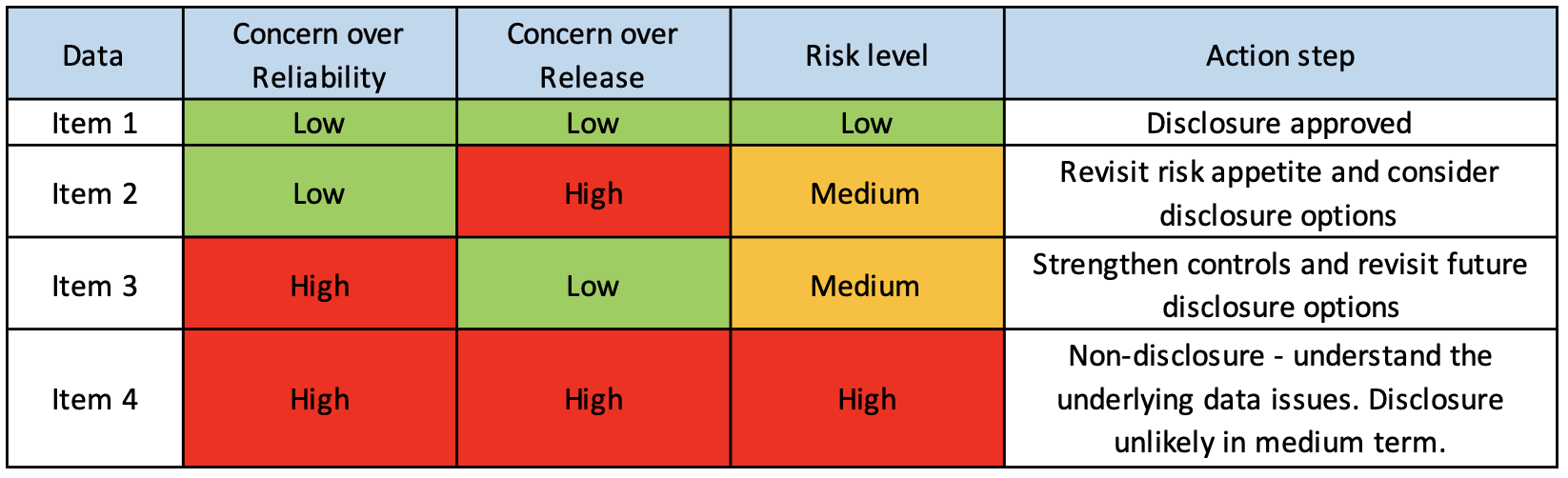
Figure 1 – Example of disclosure risk assessment grid

Conclusion

Despite pressures, there may still be a place for a corporate Sustainability Report in a post-standardisation and post-verification world.  The element that gets lost in the drive for transparency and verification is the ‘telling of management’s story’, which is about the ‘why’ behind the sustainability strategy and how these fit within the organisations core principals.  It is important this does not get lost in the rush to verify.

Alex Hindson is Partner and Head of Sustainability, Risk Consulting at Crowe UK LLP

Tags: Alex Hindson
Prev / Next

Blog

Featured
Boards do not have a risk problem.  They have a decision problem.
July 22, 2026
Boards do not have a risk problem.  They have a decision problem.
July 22, 2026

Boards now receive more risk information than ever.  Dashboards are richer, risk packs are more sophisticated and oversight frameworks are more mature.  Yet the key question is whether this has really improved the quality of board decision making.  In some organisations, more risk information has sharpened oversight.  In others, it has created more caution and more process comfort without making the decision itself any clearer.  The Risk Coalition’s recent Risk Matters roundtable considered the issues around information and decision making.

Read more →
July 22, 2026
AI governance: why boards need to look beneath the surface
June 14, 2026
Pauline Norstrom
AI governance: why boards need to look beneath the surface
June 14, 2026
Pauline Norstrom

When it comes to AI, in the boardroom there is recognition that something material is changing.  But there isn’t always a shared view of where it sits, who owns it or how it should shape decisions.  This gap matters and, with AI, the optics of governance can arrive well before the substance.

Developing frameworks and committees bring structure, provide a common language and signal that an issue is being taken seriously – but AI does not behave like traditional technology.  AI-enabled features appear inside mainstream tools and its capability can span processes, functions and suppliers in ways that are not immediately visible.  In a recent Risk Coalition roundtable, Pauline Norstrom, characterised this as an iceberg problem, and discussed the risks and challenges that all boards need to be aware of.

Read more →
June 14, 2026
Pauline Norstrom
Uncovering a hidden risk - focusing on intelligibility
May 8, 2026
Ewan Willars
Uncovering a hidden risk - focusing on intelligibility
May 8, 2026
Ewan Willars

Across sectors, there is an increasing focus by regulators on consumer understanding, as well as preventing harm and confusion by ensuring that key disclosures are made more intelligible.  At present, the form and format of disclosures prescribed by law and regulation continue to be the dominant influence on how firms communicate, from pre-sales information, terms and conditions, contractual agreements, to post-sales communications.  These rigid disclosure rules often work at odds with the ability of consumers to understand the communications, and we are now seeing regulators focus increasingly on removing prescription to ensure a focus on better outcomes.  Ewan Willars from Amplified Global discusses the changes that are taking place.  

Read more →
May 8, 2026
Ewan Willars
Go to jail.jpg
December 15, 2025
Risk Matters: ECCTA – in the Boardroom
December 15, 2025
Read more →
December 15, 2025
Strengthening risk oversight
October 27, 2025
Hanif Barma
Strengthening risk oversight
October 27, 2025
Hanif Barma

Risk governance is an essential element of decision making by organisations, even more so today in a complex, unpredictable and fast-changing business environment. Risk arrangements at board level can miss the point if they focus only on mitigating downside risk - they are in danger of losing sight of new opportunities that are necessarily grasped to ensure long-term sustainability. Hanif Barma summarises a recent roundtable discussion jointly hosted by Diligent and the Risk Coalition. A major conclusion of the discussion, which involved board members and senior risk professionals, was that a change in mindsets and behaviours was needed to drive effective risk governance.

Read more →
October 27, 2025
Hanif Barma
September 16, 2025
True, Fair... and Future-Proof: Risk Accounting for a New Era
September 16, 2025
Read more →
September 16, 2025
Risk Matters Blog – The Anatomy of a Ransomware Attack
September 16, 2025
Risk Matters Blog – The Anatomy of a Ransomware Attack
September 16, 2025
Read more →
September 16, 2025
The future of ESG: navigating a fragmented landscape
April 15, 2025
Vera Cherepanova
The future of ESG: navigating a fragmented landscape
April 15, 2025
Vera Cherepanova

The business world has long wrestled with the question of purpose beyond profit. But in the era of ESG (Environmental, Social and Governance), this debate has become more than philosophical – it’s a battleground where culture wars, regulatory demands and investor expectations collide. In this Risk Coalition blog, Vera Cherepanova looks ahead and considers the evolution and challenges of the ESG landscape, and discusses how this might evolve in future.

Read more →
April 15, 2025
Vera Cherepanova
Internal audit and risk management must work together to navigate uncertainty
March 6, 2025
Mo Warsame, Gavin Hayes
Internal audit and risk management must work together to navigate uncertainty
March 6, 2025
Mo Warsame, Gavin Hayes

Heightened economic volatility, technological disruption and geopolitical tensions impact all organisations today - whatever their sector. This means that internal audit and risk professionals are under more pressure than ever to help their organisations remain resilient. The Chartered Institute of Internal Auditors (Chartered IIA)’s new Internal Audit Code of Practice - now in force - designed to strengthen internal audit functions and support organisations in tackling these emerging risks head-on, raising the bar for the profession across financial services, private, and third sectors. Mo Warsame from the Chartered IIA explains why internal audit and risk management need to work together to navigate these ever-increasingly challenging risks.

Read more →
March 6, 2025
Mo Warsame, Gavin Hayes
Three key threats of phishing to be aware of
September 4, 2024
Polly Williams, Mia Harris
Three key threats of phishing to be aware of
September 4, 2024
Polly Williams, Mia Harris

Phishing is a significant IT risk and this risk is largely a behavioural one. It is estimated that 90% of cyber attacks originate with a phishing attack so, with cyber regularly identified by boards as one of the biggest risks their businesses faces, it is useful to be reminded what the warning signs are, and how to best prepare and respond. Polly Williams tells us how to avoid the common pitfalls.

Read more →
September 4, 2024
Polly Williams, Mia Harris
Principles versus rules in data and corporate governance
August 25, 2024
Felix Ritchie
Principles versus rules in data and corporate governance
August 25, 2024
Felix Ritchie

In the world of corporate governance, the question of whether a principles-based approach or a rules-based approach is the most effective is often a matter of debate. Different jurisdictions and different regulators take alternative approaches and, indeed, different approaches may be followed at different times. Felix Ritchie considers these two alternative approaches in his blog for the Risk Coalition. He looks at the cross-sector consultation document, Raising Your Game from the Risk Coalition and he draws on this to provides him with some lessons for data governance.

Read more →
August 25, 2024
Felix Ritchie
How can you maintain high standards in your business without suffering burnout?
July 16, 2024
Jane Hunter, Mia Harris
How can you maintain high standards in your business without suffering burnout?
July 16, 2024
Jane Hunter, Mia Harris

People risk is nowadays recognised as a very wide-ranging concept, in its many dimensions. Gone are the days when this focused solely on headcount (we haven’t got enough people! or, we can’t afford the people we have!) and their capability (we haven’t got the right skill sets!). Wellbeing is now recognised as a key part of people risk, and an important aspect of this is burnout. Burnout is a state of complete mental and physical exhaustion, where we become so overwhelmed that our performance at work can suffer, while physical and mental health issues can also affect us outside of the work environment. If not addressed and adequately managed, it can easily become a feature of high perfoming businesses. Jane Hunter discusses how to maintain high standards and high levels of performance without suffering burnout.

Read more →
July 16, 2024
Jane Hunter, Mia Harris
Enforcement of individual accountability in UK banking: a new boardroom recipe for change or continuity?
June 2, 2024
Afshan Moeed
Enforcement of individual accountability in UK banking: a new boardroom recipe for change or continuity?
June 2, 2024
Afshan Moeed

Increasing personal accountability was the focus of the Senior Managers and  Certification Regime (SMCR), introduced by the financial regulators following the 2008 financial crisis.  However, has individual accountability really resulted since the introduction of SMCR, have behaviours changed and has governance and risk culture improved?  These are questions that Afshan Moeed considered in her now-completed PhD project, and she discusses this in her blog.

Read more →
June 2, 2024
Afshan Moeed
Three exciting new developments for AI in 2024 that you need to know about
May 28, 2024
Craig Morris, Mia Harris
Three exciting new developments for AI in 2024 that you need to know about
May 28, 2024
Craig Morris, Mia Harris

Robotics and artificial intelligence have been in the public consciousness for decades, but only in recent years have we really started to comprehend the technology’s sheer potential. Businesses of any size now have the chance to leverage AI to keep up with the competition, to make better informed decisions, and to improve operational efficiency. Craig Morris discusses the key developments to watch out for in three critical sectors: healthcare, environmental sustainability and cyber security.

Read more →
May 28, 2024
Craig Morris, Mia Harris
The stuff of nightmares: risk management is shut down, and nobody notices
May 24, 2024
Stefan Hunziker
The stuff of nightmares: risk management is shut down, and nobody notices
May 24, 2024
Stefan Hunziker

Do a firm’s risk management activities actually create value? Companies increasingly spend time and money implementing a range of risk norms and frameworks whose focus is often on risk identification, analysis, and risk reporting; these are risk process activities that do not create value for decision-makers argues Stefan Hunziker. He say that, typically, nothing has been managed and no decision has been made better by these processes. In this blog, he gets to the heart of risk management - explaining that its single purpose is increasing decision quality.

Read more →
May 24, 2024
Stefan Hunziker