• About us
  • Raising the Bar
  • Raising your Game
  • The Extra G - Geopolitical
  • Risk Matters - Roundtables
  • Leadership Team
  • Events
  • Blog
  • Contact
  • Menu

The Risk Coalition

  • About us
  • Raising the Bar
  • Raising your Game
  • The Extra G - Geopolitical
  • Risk Matters - Roundtables
  • Leadership Team
  • Events
  • Blog
  • Contact

Risk in Focus - what's on the risk radar?

November 12, 2021

Whilst the rollout of vaccines across the developed world and the reopening of economies means that many of us are getting “back to normal”, the coronavirus pandemic continues to have deep impacts on businesses and all risk professionals need to adapt to a fast-changing risk landscape. 

Unsurprisingly, the Chartered Institute of Internal Auditors’ Risk in Focus annual thought-leadership research piece – a barometer of what chief audit executives (CAEs) and other risk professional across Europe consider to be the top risks facing their organisations – has very much been shaped by the pandemic. As a result, the research revealed new key areas of concerns that should be on all internal audit leaders’ radars. A prominent example is the increase in the priority of ESG risks such as human capital, diversity and talent management.  Almost half (40%) of CAEs listed this as a top five risk, which we interpret as a knock-on impact of the workplace disruption caused by the ongoing pandemic, including changes to working patterns and expectations of what work means. 

Risks currently faced by organisations - Risk in Focus 2022

Risk in Focus 2022 also sees supply chains, outsourcing and ‘nth’ party risk becoming an increasing concern whose effects we see reflected in the world around us. The news today notes chronic shortages of HGV drivers, soaring gas prices, empty petrol pumps and a lack of C02 causing gaps on supermarket shelves. Certainly, we continue to witness the fallout from the pandemic which destabilised operations and labour, disrupted supply and demand, and undermined previously sound business models to an extent few would have thought possible. 

But perhaps one of the most striking finding is the growing importance of climate change and environmental sustainability. This has been steadily rising up the agenda, with a 41% increase in the number of CAEs who view it as a top five risk, putting it in the top ten for the first time. Despite this, 7 in 10 (69%) CAEs still don’t consider it a ‘top five’ risk to their organisation, and just one in 10 (12%) of internal audit teams surveyed has said they are prioritising spending significant time and effort preparing for the ‘existential risk’ of climate change. 

These findings are especially poignant as we watch the COP26 conference unfold in Glasgow, and we urge internal audit functions to begin devoting attention to this risk if they have not done so already.

Once again, cybersecurity and data security took the top spot on the list of key risks. 82% of CAEs said this was amongst their top five risks, putting it ahead of any other risk type. Not only that, 34% of CAEs said this was their single biggest risk. This coincides with a material increase in cybercrime over the course of the pandemic, as criminals have sought to exploit the security weaknesses exposed by operational disruptions.

As well as the current risks, we asked CAEs what their priorities will be in the years to come. With new threats and challenges rising up the agenda, risk professionals must be alert to the changing landscape as they make their audit plans for the following year.  This makes Risk in Focus 2022 a vital point of reference for all risk professionals, not just in Europe but globally.
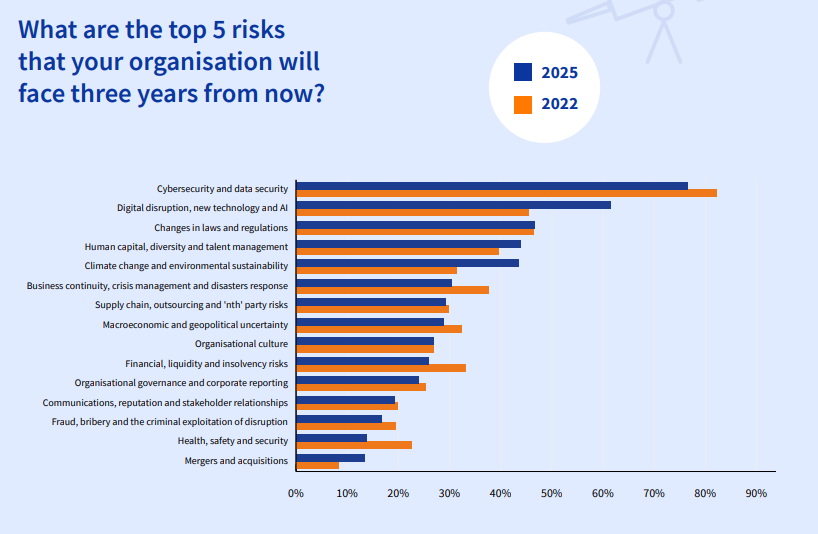
Risks expected to be faced in three years’ time by organisations - Risk in Focus 2022


Sophie Malleson is the Senior Policy and External Affairs Executive at the Chartered IIA (UK and Ireland) and the project lead for Risk in Focus. Here she outlines the key findings of Risk in Focus 2022 which shows how the risk landscape has been affected by the coronavirus pandemic.

About Risk in Focus

Risk in Focus is a forward-looking thought-leadership piece that highlights emerging risks and challenges that help audit functions develop their plans for the year ahead. 

  • research was conducted in March and April of 2021.  Data was collected through a quantitative survey among CAE members of 12 Institutes of Internal Auditors in Austria, Belgium, France, Germany, Greece, Italy, Luxembourg, the Netherlands, Spain, Sweden, Switzerland and the UK & Ireland. The survey elicited 738 responses.

  • Further insight was gathered through 50 interviews with a sample of 35 Chief Audit Executives, 12 Audit Committee Chairs and 3 CEOs from across the above listed countries.

About the Chartered Institute of Internal Auditors

The Chartered IIA represents around 10,000 internal audit professionals in organisations spanning all sectors of the economy, across the UK and Ireland. It champions the contribution internal audit makes to good corporate governance, strong risk management and a rigorous control environment leading to the long-term success of organisations, including those in the public sector.

Tags: Sophie Malleson
Prev / Next

Blog

Featured
Boards do not have a risk problem.  They have a decision problem.
July 22, 2026
Boards do not have a risk problem.  They have a decision problem.
July 22, 2026

Boards now receive more risk information than ever.  Dashboards are richer, risk packs are more sophisticated and oversight frameworks are more mature.  Yet the key question is whether this has really improved the quality of board decision making.  In some organisations, more risk information has sharpened oversight.  In others, it has created more caution and more process comfort without making the decision itself any clearer.  The Risk Coalition’s recent Risk Matters roundtable considered the issues around information and decision making.

Read more →
July 22, 2026
AI governance: why boards need to look beneath the surface
June 14, 2026
Pauline Norstrom
AI governance: why boards need to look beneath the surface
June 14, 2026
Pauline Norstrom

When it comes to AI, in the boardroom there is recognition that something material is changing.  But there isn’t always a shared view of where it sits, who owns it or how it should shape decisions.  This gap matters and, with AI, the optics of governance can arrive well before the substance.

Developing frameworks and committees bring structure, provide a common language and signal that an issue is being taken seriously – but AI does not behave like traditional technology.  AI-enabled features appear inside mainstream tools and its capability can span processes, functions and suppliers in ways that are not immediately visible.  In a recent Risk Coalition roundtable, Pauline Norstrom, characterised this as an iceberg problem, and discussed the risks and challenges that all boards need to be aware of.

Read more →
June 14, 2026
Pauline Norstrom
Uncovering a hidden risk - focusing on intelligibility
May 8, 2026
Ewan Willars
Uncovering a hidden risk - focusing on intelligibility
May 8, 2026
Ewan Willars

Across sectors, there is an increasing focus by regulators on consumer understanding, as well as preventing harm and confusion by ensuring that key disclosures are made more intelligible.  At present, the form and format of disclosures prescribed by law and regulation continue to be the dominant influence on how firms communicate, from pre-sales information, terms and conditions, contractual agreements, to post-sales communications.  These rigid disclosure rules often work at odds with the ability of consumers to understand the communications, and we are now seeing regulators focus increasingly on removing prescription to ensure a focus on better outcomes.  Ewan Willars from Amplified Global discusses the changes that are taking place.  

Read more →
May 8, 2026
Ewan Willars
Go to jail.jpg
December 15, 2025
Risk Matters: ECCTA – in the Boardroom
December 15, 2025
Read more →
December 15, 2025
Strengthening risk oversight
October 27, 2025
Hanif Barma
Strengthening risk oversight
October 27, 2025
Hanif Barma

Risk governance is an essential element of decision making by organisations, even more so today in a complex, unpredictable and fast-changing business environment. Risk arrangements at board level can miss the point if they focus only on mitigating downside risk - they are in danger of losing sight of new opportunities that are necessarily grasped to ensure long-term sustainability. Hanif Barma summarises a recent roundtable discussion jointly hosted by Diligent and the Risk Coalition. A major conclusion of the discussion, which involved board members and senior risk professionals, was that a change in mindsets and behaviours was needed to drive effective risk governance.

Read more →
October 27, 2025
Hanif Barma
September 16, 2025
True, Fair... and Future-Proof: Risk Accounting for a New Era
September 16, 2025
Read more →
September 16, 2025
Risk Matters Blog – The Anatomy of a Ransomware Attack
September 16, 2025
Risk Matters Blog – The Anatomy of a Ransomware Attack
September 16, 2025
Read more →
September 16, 2025
The future of ESG: navigating a fragmented landscape
April 15, 2025
Vera Cherepanova
The future of ESG: navigating a fragmented landscape
April 15, 2025
Vera Cherepanova

The business world has long wrestled with the question of purpose beyond profit. But in the era of ESG (Environmental, Social and Governance), this debate has become more than philosophical – it’s a battleground where culture wars, regulatory demands and investor expectations collide. In this Risk Coalition blog, Vera Cherepanova looks ahead and considers the evolution and challenges of the ESG landscape, and discusses how this might evolve in future.

Read more →
April 15, 2025
Vera Cherepanova
Internal audit and risk management must work together to navigate uncertainty
March 6, 2025
Mo Warsame, Gavin Hayes
Internal audit and risk management must work together to navigate uncertainty
March 6, 2025
Mo Warsame, Gavin Hayes

Heightened economic volatility, technological disruption and geopolitical tensions impact all organisations today - whatever their sector. This means that internal audit and risk professionals are under more pressure than ever to help their organisations remain resilient. The Chartered Institute of Internal Auditors (Chartered IIA)’s new Internal Audit Code of Practice - now in force - designed to strengthen internal audit functions and support organisations in tackling these emerging risks head-on, raising the bar for the profession across financial services, private, and third sectors. Mo Warsame from the Chartered IIA explains why internal audit and risk management need to work together to navigate these ever-increasingly challenging risks.

Read more →
March 6, 2025
Mo Warsame, Gavin Hayes
Three key threats of phishing to be aware of
September 4, 2024
Polly Williams, Mia Harris
Three key threats of phishing to be aware of
September 4, 2024
Polly Williams, Mia Harris

Phishing is a significant IT risk and this risk is largely a behavioural one. It is estimated that 90% of cyber attacks originate with a phishing attack so, with cyber regularly identified by boards as one of the biggest risks their businesses faces, it is useful to be reminded what the warning signs are, and how to best prepare and respond. Polly Williams tells us how to avoid the common pitfalls.

Read more →
September 4, 2024
Polly Williams, Mia Harris
Principles versus rules in data and corporate governance
August 25, 2024
Felix Ritchie
Principles versus rules in data and corporate governance
August 25, 2024
Felix Ritchie

In the world of corporate governance, the question of whether a principles-based approach or a rules-based approach is the most effective is often a matter of debate. Different jurisdictions and different regulators take alternative approaches and, indeed, different approaches may be followed at different times. Felix Ritchie considers these two alternative approaches in his blog for the Risk Coalition. He looks at the cross-sector consultation document, Raising Your Game from the Risk Coalition and he draws on this to provides him with some lessons for data governance.

Read more →
August 25, 2024
Felix Ritchie
How can you maintain high standards in your business without suffering burnout?
July 16, 2024
Jane Hunter, Mia Harris
How can you maintain high standards in your business without suffering burnout?
July 16, 2024
Jane Hunter, Mia Harris

People risk is nowadays recognised as a very wide-ranging concept, in its many dimensions. Gone are the days when this focused solely on headcount (we haven’t got enough people! or, we can’t afford the people we have!) and their capability (we haven’t got the right skill sets!). Wellbeing is now recognised as a key part of people risk, and an important aspect of this is burnout. Burnout is a state of complete mental and physical exhaustion, where we become so overwhelmed that our performance at work can suffer, while physical and mental health issues can also affect us outside of the work environment. If not addressed and adequately managed, it can easily become a feature of high perfoming businesses. Jane Hunter discusses how to maintain high standards and high levels of performance without suffering burnout.

Read more →
July 16, 2024
Jane Hunter, Mia Harris
Enforcement of individual accountability in UK banking: a new boardroom recipe for change or continuity?
June 2, 2024
Afshan Moeed
Enforcement of individual accountability in UK banking: a new boardroom recipe for change or continuity?
June 2, 2024
Afshan Moeed

Increasing personal accountability was the focus of the Senior Managers and  Certification Regime (SMCR), introduced by the financial regulators following the 2008 financial crisis.  However, has individual accountability really resulted since the introduction of SMCR, have behaviours changed and has governance and risk culture improved?  These are questions that Afshan Moeed considered in her now-completed PhD project, and she discusses this in her blog.

Read more →
June 2, 2024
Afshan Moeed
Three exciting new developments for AI in 2024 that you need to know about
May 28, 2024
Craig Morris, Mia Harris
Three exciting new developments for AI in 2024 that you need to know about
May 28, 2024
Craig Morris, Mia Harris

Robotics and artificial intelligence have been in the public consciousness for decades, but only in recent years have we really started to comprehend the technology’s sheer potential. Businesses of any size now have the chance to leverage AI to keep up with the competition, to make better informed decisions, and to improve operational efficiency. Craig Morris discusses the key developments to watch out for in three critical sectors: healthcare, environmental sustainability and cyber security.

Read more →
May 28, 2024
Craig Morris, Mia Harris
The stuff of nightmares: risk management is shut down, and nobody notices
May 24, 2024
Stefan Hunziker
The stuff of nightmares: risk management is shut down, and nobody notices
May 24, 2024
Stefan Hunziker

Do a firm’s risk management activities actually create value? Companies increasingly spend time and money implementing a range of risk norms and frameworks whose focus is often on risk identification, analysis, and risk reporting; these are risk process activities that do not create value for decision-makers argues Stefan Hunziker. He say that, typically, nothing has been managed and no decision has been made better by these processes. In this blog, he gets to the heart of risk management - explaining that its single purpose is increasing decision quality.

Read more →
May 24, 2024
Stefan Hunziker